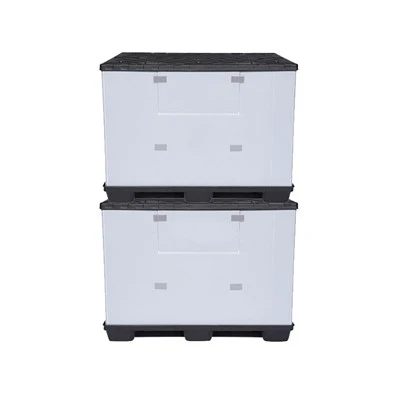
Plastic pallet containers and standard plastic crates both fall under the category of reusable plastic logistics containers. While they may appear similar-both being injection-molded from industrial-grade HDPE or PP and designed for repeated use-they differ fundamentally in terms of structural design, load-bearing capacity, handling methods, return logistics, and application scenarios. Consequently, they cannot be treated as simple, interchangeable alternatives within a supply chain.Plastic pallet containers and standard plastic crates both fall under the category of reusable plastic logistics containers. While they may appear similar-both being injection-molded from industrial-grade HDPE or PP and designed for repeated use-they differ fundamentally in terms of structural design, load-bearing capacity, handling methods, return logistics, and application scenarios. Consequently, they cannot be treated as simple, interchangeable alternatives within a supply chain.
Differences in Dimensions
Pallet containers and standard plastic turnover crates represent two distinct product lines. The former are built upon a 1200×1000 mm pallet base-adhering to EUR/EPAL or GMA standard dimensions-and are designed for direct integration with pallet racking, forklifts, and full-pallet logistics workflows. The latter utilize smaller modular units, such as 600×400 mm or 800×600 mm, which are tailored for production lines, sorting systems, and automated storage and retrieval systems (AS/RS). Consequently, these two categories follow different dimensional standards and are not directly interchangeable.

Differences in Load Capacity
There is also a significant disparity in load-bearing capacity. Pallet containers manufactured via structural foam injection molding typically offer a dynamic load capacity of 1000 kg, a static load capacity of 4000 kg, and a racking load capacity of 500 kg, allowing them to be stored across rack beams without the need for additional steel reinforcement. In contrast, standard turnover crates generally have dynamic and static load capacities of around 30 kg, with an individual unit weight of 1.8 kg. Even heavy-duty versions-equipped with reinforcing ribs and steel inserts-are typically limited to a static stacking capacity of approximately 500 kg. This difference stems from variations in wall thickness and core-layer structural design.

Differences in Manufacturing Processes
The molding processes also differ. Pallet containers are produced via structural foam injection molding, where a honeycomb core is encased within a solid outer skin, balancing rigidity with a lightweight design. Logistics crates (totes) are manufactured in a single-shot process using 1,600- to 4,000-ton injection molding machines, with a focus on uniform thin-wall thickness and high-precision stacking interfaces. Critical tolerances for both are maintained within ±0.5 mm, verified using coordinate measuring machines (CMM).
Structural Design
The design of the base directly dictates handling methods. Pallet containers feature three types of bases-nine-foot, three-runner, or two-skid-designed for four-way forklift entry, high-bay racking storage, and roller conveyor transport, respectively. The bases of logistics crates are typically solid, flat surfaces or reinforced grids, often incorporating slots for robotic grippers and anti-slip textures to facilitate use in automated storage and retrieval systems (AS/RS) and with stacker cranes.

Return Volume
This is an often-overlooked factor. Collapsible sleeve-pack pallet containers can reduce return volume for empty units by 80%, while collapsible crates offer a 70% reduction, and nestable (stackable-when-empty) crates save 60% of space. In high-volume, closed-loop logistics scenarios, this factor often has a greater impact on total cost than the initial unit purchase price.

Materials and Accessories
HDPE offers resistance to low-temperature impact (down to -30°C), making it ideal for cold chain logistics and agricultural harvesting. PP is resistant to oils and cleaning agents, withstands temperatures up to 90°C, and is well-suited for the cleaning of automotive parts as well as general manufacturing lines. Solid-walled containers prevent liquid leakage, while perforated-walled versions facilitate ventilation and cooling for fresh produce. Pallet containers can be equipped with drop-down access doors, RFID pockets, and designated areas for barcodes, whereas smaller turnover boxes typically feature integrated handles and optional lids.
When selecting the right equipment, consider the weight of individual items and the specific stage of the logistics flow. Use pallet containers for heavy individual items, full-pallet handling, racking storage, or long-haul transport. Conversely, use smaller turnover boxes for lighter items that require high-frequency handling-for instance, moving goods between production lines and automated storage systems. Using a pallet container as a standard turnover box leads to wasted space and higher shipping costs for empty returns; conversely, forcing a turnover box into a pallet-based workflow compromises stacking stability. Therefore, it is essential to clearly understand the fundamental differences between these two types of containers to ensure they are used effectively.